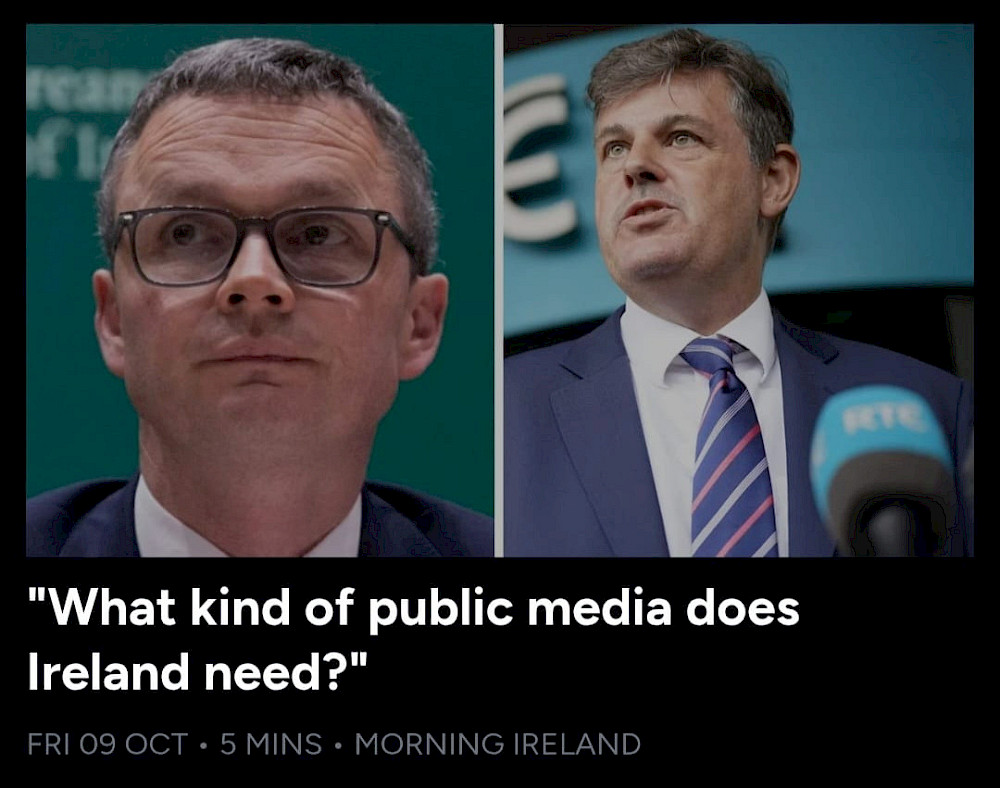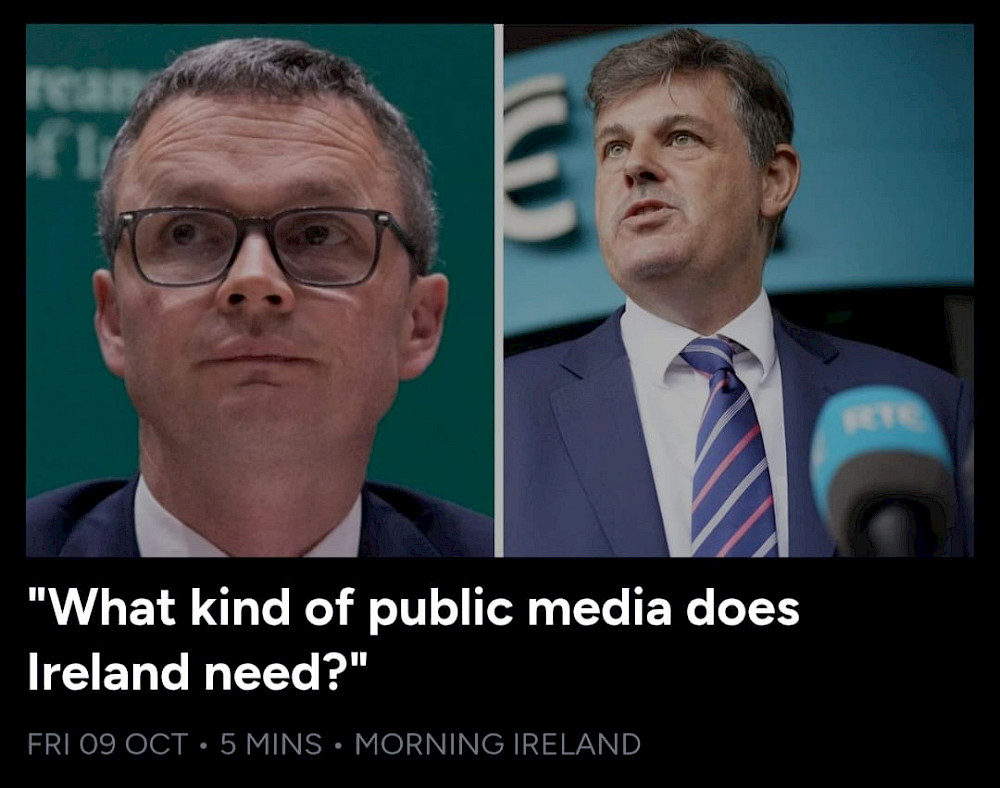

Speaking on RTÉ’s Morning Ireland, Dr Eileen Culloty, Deputy Director of FuJo, argues that Ireland needs a broader debate about the future of public service media, its funding model and the role it plays in a healthy democracy.
Dr Culloty appeared on RTÉ Radio 1’s Morning Ireland on Friday, October 9, 2026, to discuss the latest developments in RTÉ’s funding, following the government’s decision to cut funding in response to concerns about the pace of reform.
She argued that the controversy should be understood in the context of a much longer-running failure to establish a clear vision for public service media in Ireland and to agree on how it should be funded.
“There’s been a lot of criticism of Minister O’Donovan, and much of that criticism is deserved. But I see the story as just the latest episode in a decades-long saga about the funding of RTÉ and public media,” she said.
"Every time one of these episodes blows up, we get a lot of coverage, we get a lot of political grandstanding. […] But the big, core decisions, there’s never any action on them. And those decisions are: what kind of public media does Ireland need going into the rest of the twenty-first century, and how should that be funded?"
For Eileen, the failure to answer these questions is ultimately a political one. The immediate controversy, she argued, should not distract from the need for a long-term funding settlement and a wider public debate about the future of public service media.
Rethinking how public service media is funded
She also questioned the continued reliance on the television licence fee as the basis for funding public service media in a changing media landscape.
“I find it astonishing that we’re still talking about a TV licence fee. It’s 2026. People don’t go out and buy TVs, that’s not how people consume media,” she said.
She outlined the main options for funding public media: public funding, funding through the Exchequer, commercial income, or a combination of these approaches. Each comes with challenges. Commercial funding can lead to increasingly commercialised media, while direct Exchequer funding can leave public broadcasters vulnerable to political interference.
A licence fee or levy, meanwhile, raises questions about how contributions should be collected and distributed in a way that reflects contemporary media consumption.
“I think we’re going to have to talk about a public levy, whether that’s a progressive household charge, or some kind of progressive tax. But this is what other countries are doing,” she said.
She added that Ireland could learn from other European countries with similar characteristics, rather than continuing to revisit the same questions without reaching a decision.
“The real problem has been a lack of political will to do anything. So, in effect, successive Irish governments have just been managing the decline of RTÉ.”
Funding, reform and editorial independence
The immediate dispute also raises questions about the relationship between government funding decisions and the independence of public service broadcasting.
Dr Culloty argued that direct annual funding can give political actors excessive leverage over public broadcasters. Even where concerns about the pace of reform are legitimate, she said, withdrawing funding at short notice is not an appropriate way to exercise oversight.
“It is deeply irresponsible to just withdraw money at the last moment, when that money was already committed, to jobs in RTÉ, but also to the independent production sector that RTÉ supports. It’s not how you exercise oversight,” she said.
She also pointed to the European Media Freedom Act (EMFA) and the importance of protecting public broadcasting from arbitrary political decisions.
“They committed to a plan, and they committed to multi-annual funding. And the European Media Freedom Act, which I would assume the government would say it supports, specifically says that we need to protect public broadcasting from arbitrary judgements.”
In the immediate term, she argued, the government should honour its commitment to fund RTÉ’s existing plan. Over the longer term, Ireland needs a more comprehensive approach to public media funding, supported by a broader public debate.
What kind of public media does Ireland need?
For Eileen, the question goes beyond the future of RTÉ as it currently exists. It concerns the kind of media infrastructure Irish society needs in a period of geopolitical uncertainty, democratic pressure and increasing media ownership concentration.
“People don’t have to like RTÉ, and people don’t have to especially like the RTÉ that we have. The conversation needs to be about, going into the kind of geopolitical uncertainty that we have, the attacks on democracy that are happening across the Western world, the buying up of media that we’re seeing across the Western world, what does Irish democracy and Irish society need for media, let’s commit to funding that, and commit to building it.”
That might mean a public service media organisation that looks very different from the RTÉ of today. What matters, she argued, is that Ireland decides what it needs and commits to supporting it.
“Even though there was an entire Future of Media Commission back in 2020. But nothing ever happens.”
The immediate priority, she concluded, should be for the government to follow through on its existing funding commitments. But that must be followed by a longer-term plan and a meaningful public conversation about the future of public service media in Ireland.